

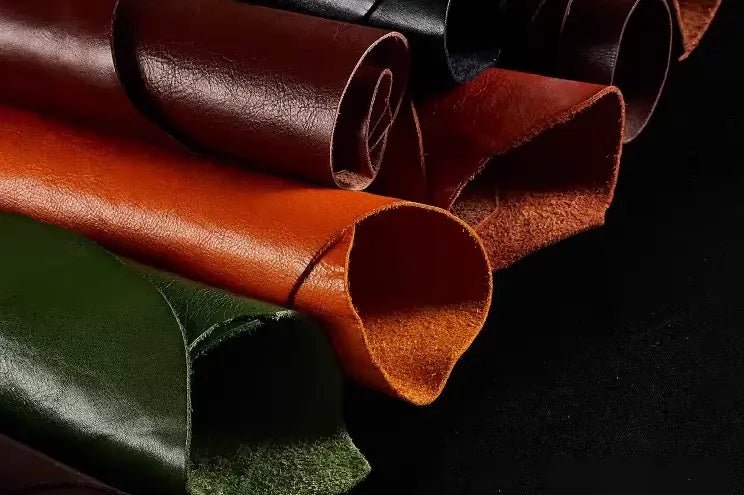
Chrome-tanned leather is animal hide that has been transformed into leather with chromium(III) tanning salts, most commonly basic chromium sulfate. The chromium compounds stabilize the hide’s collagen fibers, so the material no longer rots or dries into a hard, brittle sheet. It is the most widely used tanning method in modern leather production.
The word “chrome” can make the process sound mysterious or alarming. In leather, however, it does not mean a chrome-plated surface. It describes the tanning chemistry used inside the hide. The process is carefully controlled: the hide is first prepared and acidified, chromium(III) salts are allowed to penetrate it, and the pH is then raised so the tanning agents bind more securely to the collagen. The result is an intermediate leather known as wet blue, which is later retanned, dyed, softened, dried, and finished for its final use.
First, What Does “Tanning” Mean?
Fresh hide is not yet leather. It contains collagen, water, fats, and proteins, and it will decompose if it is not preserved and converted. If raw hide simply dries, its fibers stick together and the material becomes stiff and brittle. Tanning changes the fiber structure so the collagen remains stable, durable, and usable.
Chrome tanning is one way of doing that. Vegetable tanning uses plant tannins; chrome tanning uses chromium(III) salts. Neither term tells you whether a leather is full grain, top grain, corrected grain, or split. Those describe the hide layer and surface treatment, not the tanning method.
What Is Actually Used in Chrome Tanning?
The main tanning agent is usually basic chromium sulfate, a chromium(III) compound dissolved in water. Chromium(III), often written as Cr(III), is the form used in conventional chrome tanning. It should not be confused with chromium(VI), a different oxidation state that is a regulated hazard. Responsible tanneries control their chemistry, process conditions, and materials to prevent the formation of chromium(VI) in finished leather.
During tanning, chromium complexes move into the hide and interact with collagen. Once properly fixed, they help stabilize the fiber network against heat and biological breakdown. This is why tanning is more than dyeing or coating: the change takes place throughout the hide structure.
How Is Chrome-Tanned Leather Made?

The exact recipe changes with the animal, thickness, tannery, and final product. A soft garment leather, an automotive upholstery leather, and a shoe upper may all start with chrome tanning but receive different post-tanning treatments. Still, the main stages follow the same logic.
-
Curing and soaking
Fresh hides are commonly preserved before reaching the tannery, often with salt. At the tannery, soaking rehydrates the hides and removes dirt, salt, blood, and soluble proteins. This gives the tannery a clean, evenly hydrated starting point.
-
Liming, fleshing, and deliming
The hides are treated to loosen hair and epidermis, then the hair is removed and excess flesh and fat are trimmed away. Liming also opens up the fiber structure. Afterward, deliming lowers the alkalinity, and bating uses enzymes to clean and soften the pelt. The purpose is not simply to make the hide thinner; it prepares the collagen structure so the tanning agents can enter evenly.
-
Pickling: preparing the hide for chromium
Before chrome tanning, the pelt is treated with salt and acid. This stage is called pickling. It lowers the pH and puts the collagen into the right condition for chromium complexes to penetrate deeply and evenly. If chromium were fixed too quickly at the surface, the center could remain insufficiently tanned, so penetration must happen before fixation.
-
Chrome tanning: penetration first, fixation second
The pickled hides are put into a rotating drum with a chromium(III) tanning liquor. At the acidic pH used early in this stage, the chromium complexes are small enough to move through the fiber network. The drum action continuously circulates the liquor and helps keep treatment even.
Once the chromium has penetrated, the tannery gradually raises the pH, a stage called basification. As the conditions change, the chromium complexes become more reactive with the collagen and bind more firmly within the hide. This controlled sequence, rather than the mere addition of a “chrome chemical,” is the core of chrome tanning.
-
Why the leather becomes wet blue
After chrome tanning, the hide is wet and usually has a pale bluish cast. At this point it is called wet blue. “Wet blue” is an intermediate manufacturing stage: the hide is already tanned and stable, but it is not yet the finished leather used for a bag, jacket, sofa, or pair of shoes.
From Wet Blue to Finished Leather

Wet blue is only the start of the leather article. It is typically sorted, split or shaved to a controlled thickness, then taken through wet finishing. These later steps have a major effect on how the final leather feels and performs.
Retanning adds selected tanning agents to adjust body, fullness, firmness, grain tightness, and dye behavior. Dyeing gives the leather its color. Fatliquoring introduces specially prepared oils that lubricate the fibers, keeping them from sticking together as the leather dries. That is a major reason many chrome-tanned leathers can feel soft and flexible rather than board-like.
After drying, the leather may be softened mechanically, buffed, embossed, coated, waxed, or otherwise finished. A smooth, protective pigment finish and a natural aniline finish can both exist on chrome-tanned leather; the visible surface is determined by finishing choices, not chrome tanning alone.
Why Does Chrome-Tanned Leather Often Feel Soft?

Chrome tanning gives a stable base, but softness is the combined result of the entire leather-making system: the hide selection, chrome tannage, retanning, amount and type of fatliquor, shaving, drying, mechanical softening, and surface finish. That is why “chrome tanned” does not automatically mean one exact hand feel.
In broad terms, chrome-tanned leather is valued because it can be made supple, lightweight, and available in a wide range of colors and finishes. These traits make it especially common for footwear, handbags, garments, upholstery, gloves, and many small leather goods. Some chrome-tanned leathers are still firm and structured; they have simply been engineered for a different use.
Chrome Tanning and Vegetable Tanning: A Short Comparison
The useful distinction is not “good versus bad.” Chrome tanning is generally chosen when a tannery needs efficient production and a leather article that can be soft, flexible, consistently colored, or highly finishable. Vegetable tanning is often chosen when makers want a firmer, more natural-looking leather that can be tooled, molded, and allowed to develop a pronounced patina.
A product’s quality depends on far more than tannage. Hide quality, grain selection, thickness, dyeing, finishing, construction, and whether the material suits the product all matter.
Common Misunderstandings
Chrome tanned does not mean low grade
It is a production method, used across a huge range of qualities and product categories.
Wet blue does not mean finished leather is blue
Most wet blue is further processed, colored, and finished into the familiar shades buyers see in stores.
Chrome-free and vegetable tanned are not interchangeable
Chrome-free means chromium was not used in the tannage; it may refer to vegetable tanning or to other mineral, aldehyde, or synthetic tanning systems.
Final Takeaway
Chrome-tanned leather is leather made by using chromium salts to stabilize animal hide. Its key moment is the controlled transition from acidic penetration to basification and fixation, which turns prepared hide into wet blue. Everything that follows, including retanning, dyeing, fatliquoring, drying, and finishing, determines the leather’s final softness, color, surface, and purpose. Once you separate those stages, “chrome tanned” becomes much clearer: it is a tanning method, not a shortcut for quality, feel, or appearance.
%20tanning%20salts,%20most%20commonly%20basic%20chromi...)
Leave a comment
This site is protected by hCaptcha and the hCaptcha Privacy Policy and Terms of Service apply.