
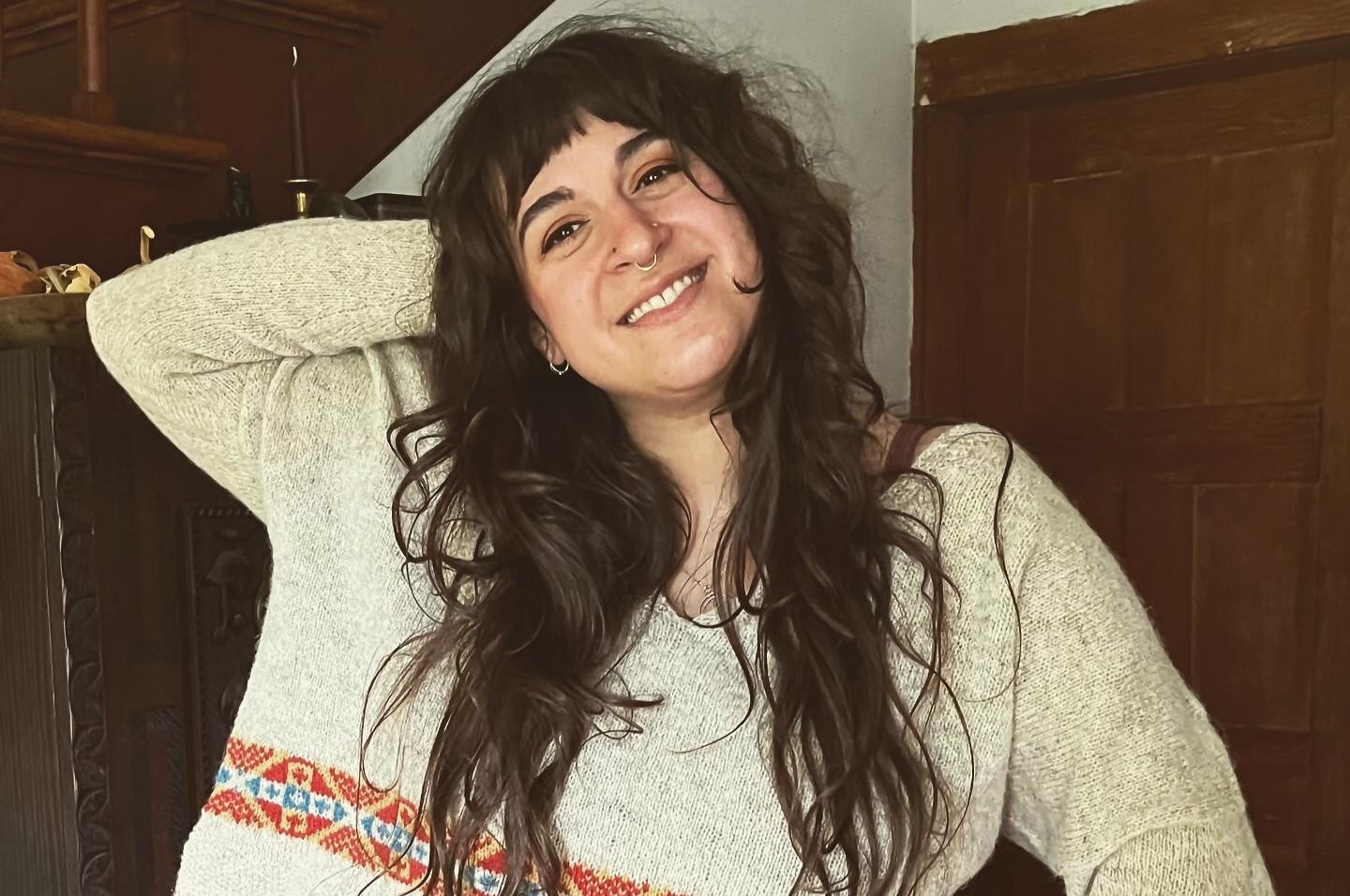
Caprine Cottage — Where Fiber Meets the Land
 In the Finger Lakes region of central New York, Anne tends to a vegetable farm she shares with seven goats, a few cows, a revolving cast of chickens, and three cats. Her YouTube channel, Caprine Cottage (YouTube: @caprinecottage, Instagram: @caprinecottage), offers a window into this life—one shaped equally by the rhythms of the growing season and the patient, unhurried cadence of handcraft. The channel’s name itself is a small declaration of identity: “caprine,” from the Latin for goat, signals that this is not a studio operation but something rooted in the land, in animals, in seasons that cannot be rushed.
Seasons on the Farm, Seasons at the Wheel
The most distinctive quality of Caprine Cottage is how naturally it folds making into the calendar of a working farm. Anne’s content does not exist in the ambient, season-free space of most craft channels.
Instead, it moves with the land. Her summer farm vlogs are immersive documents of rural life at its busiest: goat walks through tall grass, hay-making under wide skies, the harvesting of herbs and dye plants from her garden, and the quiet satisfaction of turning a surplus of rhubarb into jars of jam and juice while the spinning wheel hums nearby. These are not staged lifestyle montages. They carry the dust and weight of real agricultural work—the kind where your hands are in the soil before they are in the yarn.
 By autumn, the pace shifts. Harvest demands peak, and Anne’s podcast episodes take on a reflective tone—catching the viewer at the moment when the last of the season’s abundance is being gathered and the slower, inward-facing months are beginning to settle in.
She has described this transitional period as being “wild”—so busy with the height of the harvest that knitting becomes something you reach for in the quieter pockets of the day, rather than the center of it. Yet that tension between agricultural urgency and creative patience is precisely what gives her content its texture. The farm does not pause for a knitting update, and Anne does not pretend otherwise.
Winter brings gift-knitting plans and the particular pleasure of working through personal projects while snow covers the fields. Anne approaches this season with an unhurried intentionality, mapping out handmade gifts for the holidays—a practice she has extended into DIY holiday gift-making that goes beyond yarn, incorporating soap-making and other handcrafted goods.
 There is a deep logic to this: when you live on a farm where raw materials are always within reach, the impulse to make rather than buy becomes second nature. The rhythm is recognizable to anyone who lives close to the land—there are seasons for planting, seasons for harvesting, and seasons for sitting by the fire with needles in hand.
What sets Anne’s fiber practice apart from nearly every other knitting creator online, however, is where it begins. Most knitting YouTubers start at the yarn shop. Anne starts at the fleece. Her educational series, Caprine Craft, documents the full journey from raw sheep’s wool to hand-spun yarn—washing, carding, spinning—each step carried out by hand.
The first installment of this series serves as a kind of founding statement for the channel: a meticulous, unhurried walkthrough of how dirty wool becomes usable fiber. Later installments extend this process into natural plant dyeing, using marigolds grown in her own garden to produce warm golden tones on freshly spun fiber.
This is not a curated aesthetic choice; it is a logical extension of farm life. When you raise animals and tend a garden, the materials for making are already at your doorstep. The entire supply chain, from field to finished object, can be held in a single pair of hands.
 This fleece-to-fabric sensibility gives Anne a relationship to her materials that most makers simply do not have. She knows what the wool felt like before it was washed. She knows which plant produced the color. When she knits with her own hand-spun yarn—as she has shown in multiple podcast updates—the finished garment carries a provenance that commercial yarn cannot replicate. It is this depth of connection to material that makes Caprine Cottage feel less like a content channel and more like an ongoing record of a life being made by hand.
Shetland, Rhinebeck, and the Wider Fiber World
If the farm provides the foundation for Anne’s practice, the Shetland Islands provided a pivotal creative turning point. In a dedicated podcast episode, Anne shared the story of her trip to Shetland—the remote Scottish archipelago whose centuries-old knitting traditions remain a touchstone for fiber artists worldwide.
 Audrey in Unst Vest
She returned with purchases from local makers, a deeper understanding of Shetland construction techniques, and a creative direction that would shape much of her subsequent work. For someone already committed to the full cycle of fiber production on her own farm, Shetland’s tradition of place-rooted making—where the sheep, the wool, the knitter, and the landscape are all part of the same ecosystem—must have felt less like a discovery than a confirmation.
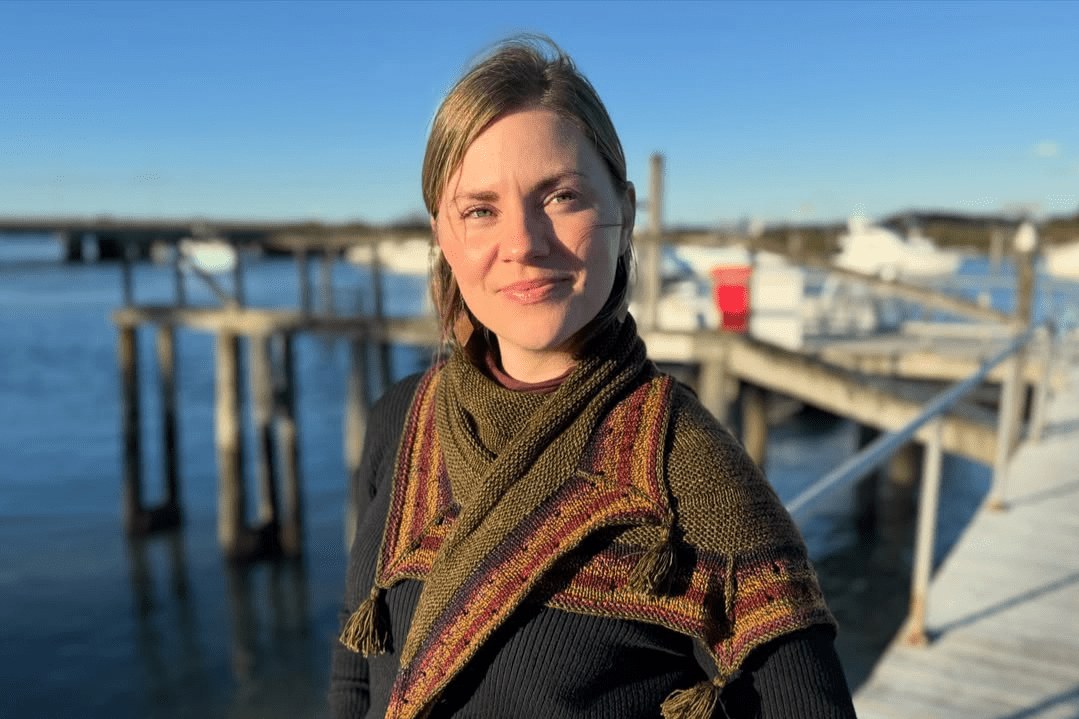
The influence has been visible across her project queue ever since. Her completed Audrey in Unst Vest—named for the northernmost inhabited island in the Shetland chain, famous for its lace knitting heritage—stands as a signature piece.
She described finishing it with a sense of deep satisfaction, the kind that comes not from speed but from the accumulated patience of months of careful work. Her Peerie Shop Cardi, another Shetland-inspired garment, was finished just in time for the 2025 Rhinebeck festival, while a more ambitious Burra project—named after the Shetland island south of Lerwick—remained on the needles, a work-in-progress she openly wished she could have completed before the event. These are not isolated projects pulled from a pattern library at random. They form a coherent thread, a sustained engagement with a single knitting tradition that deepens with each garment.
 Peerie Shop Cardi
Rhinebeck itself—the New York State Sheep and Wool Festival, held each October at the Dutchess County Fairgrounds—has become a significant annual event in Anne’s creative calendar. She attended in both 2024 and 2025, dedicating podcast episodes to the experience: a vlog documenting the day itself, and a separate haul episode sharing her acquisitions.
For a fiber artist living in the Finger Lakes, Rhinebeck is a relatively short journey, but its significance is outsized. It is one of the largest fiber arts gatherings in the country, drawing over thirty thousand visitors, and for Anne it serves as a point of connection with the broader maker community—a place to see new work, encounter new yarns, and be reminded that the practice she carries on in relative solitude on her farm is part of a much larger, living tradition.
 Across all of this, Anne’s project updates reveal a maker whose interests extend well beyond any single technique. Knitting remains the primary thread—the Isla Shawl, the Sea Tarra, the Sophie Scarf, the Shelterwood Cap, the Tarra Shawl—but spinning, weaving, sewing, and natural dyeing all surface regularly, each treated not as a separate hobby but as a facet of a single, integrated practice.
A New Material, a Familiar Rhythm
Anne’s connection to leatherwork did not begin with Babylon Leather. As a child, she had her first encounter with the craft at a summer camp, an early tactile memory that stayed with her long after the camp ended.
When the opportunity arose to collaborate with Babylon Leather on a Lindy-Style Leather Bag DIY Craft Kit in Caramel with gold hardware, it was less a departure than a return.
True to form, Anne chose the higher-difficulty version of the kit. The two-needle hand-stitching process required a different kind of attention than knitting—slower, more deliberate, with less room for improvisation—but the underlying logic was familiar: quality materials, careful technique, and the satisfaction of building something functional with your own hands.

For someone accustomed to the long arc from raw fleece to finished garment, the structured precision of a Babylon Leather kit offered a complementary experience—less open-ended, but no less rewarding. After the collaboration, Anne went on to purchase additional Babylon Leather products on her own, a quiet endorsement that spoke more clearly than any scripted review.
A Practice, Not a Performance
In a digital landscape that often rewards speed, polish, and constant reinvention, Caprine Cottage operates on a different frequency. Anne’s content moves at the pace of the farm—unhurried, seasonal, attentive to the kind of details that most people overlook. She does not chase trends or optimize for algorithms. She processes wool because the sheep need shearing. She dyes yarn because the marigolds are blooming. She knits because it is winter, and winter is for knitting.
 What makes her channel compelling is not any single spectacular project or viral moment, but the steady accumulation of a life being built by hand. From the raw fleece washed in her farmhouse to the Shetland-inspired vest worn to Rhinebeck, from the marigold dye bath in her garden to the Pelica Vest knitted alongside her growing community—each piece is a coordinate on a map of intentional living. For anyone who has felt drawn to a quieter, more rooted way of making, her corner of the internet offers a steady, grounding reminder: this kind of life is not a fantasy. It is a practice—built one fleece, one dye bath, one stitch, one season at a time.

댓글 남기기
이 사이트는 hCaptcha에 의해 보호되며, hCaptcha의 개인 정보 보호 정책 과 서비스 약관 이 적용됩니다.