

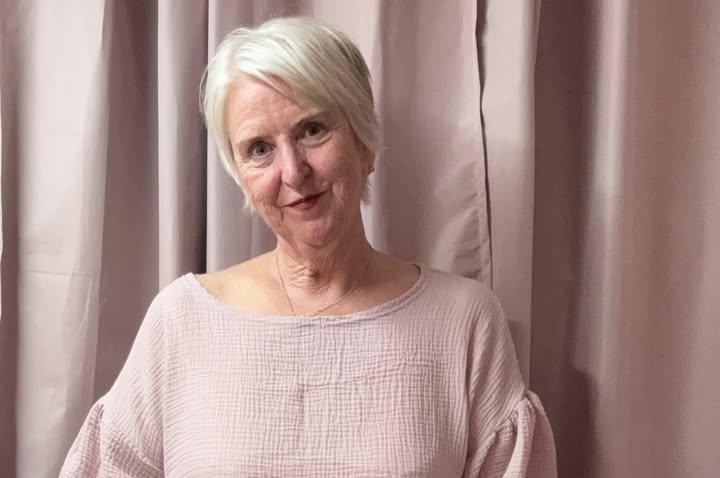
There is something fitting about a knitting podcast that introduces itself through place. Knitting By The Bay shares “knitting patterns and inspiration from a little town on Georgian Bay, Canada,” a simple description that immediately sets the pace: local, unhurried, and grounded in the everyday life of making. Since the YouTube channel began in 2023, its creator has built a growing corner of the knitting community around projects, materials, patterns, and the steady pleasure of returning to work made by hand. The channel feels less like a performance of expertise and more like an invitation to sit alongside another maker. Yet the public traces around Knitting By The Bay also suggest that this current chapter did not begin with YouTube. Behind the podcast is a much longer familiarity with patterns, sewing, needlework, and the practical language of turning an idea into something tangible.
A Creative Practice with a Longer Memory
One of the clearest clues to that longer history appears in the channel’s own public contact information: the email address still carries the name “Dear Sukie.” That name also belongs to an older public craft footprint built around pattern-based making. Photographs published under the Dear Sukie name in the early 2010s show sewn accessories such as wallets and small card holders. Later, the same maker identity became strongly associated with counted cross-stitch patterns, including floral pieces, seasonal samplers, animals, alphabet designs, and playful motifs intended for everyday stitchers.

It is worth being careful with this history. Knitting By The Bay does not present a formal public biography that turns every stage into a neat timeline, and there is no reason to invent one. What the available work does show, however, is a consistent creative vocabulary. Long before the current knitting podcast, there was already an interest in patterns as a bridge between imagination and execution: something designed clearly enough that another person could follow it, adapt it to their own hands, and experience the satisfaction of finishing the piece themselves.
The Dear Sukie pattern world also reveals something about how she approaches craft. Public pattern descriptions emphasize readable charts, straightforward instructions, approachable projects, and the calming focus of repetitive handwork. Free charts and practical tools such as a cross-stitch calculator sit alongside paid patterns. That mixture of design and usefulness matters. It suggests a maker who is interested not only in what an object looks like when it is finished, but also in whether the route toward that object feels understandable and possible.

Seen from that perspective, Knitting By The Bay feels less like a sudden reinvention than a natural change of medium. Sewing asks a maker to understand construction. Cross stitch trains the eye to read a grid, count carefully, and trust incremental progress. Knitting introduces another system of structure, repetition, material choice, fit, and pattern interpretation. Each craft has its own physical language, but all of them reward the same kind of attention: patience, observation, and the willingness to solve a larger object one small action at a time.
The most meaningful creative turn, then, may be the move from making and designing privately or through static patterns to sharing the process in a conversational video format. A pattern is necessarily compressed. It tells another maker what to do, but much of the lived experience remains between the lines. A podcast can hold those in-between moments: why a project is appealing, what a material feels like in practice, what changes as the work progresses, and why one project leads naturally to another. In that sense, the channel expands a long-standing interest in craft instruction into something more personal without needing to make private life the subject. The making itself becomes the story.
Turning Process into Community

That distinction matters because knitting is unusually well suited to long-form, process-centered storytelling. A hand-knit piece takes time, and much of its value happens between the cast-on and the finished-object reveal. Knitting By The Bay’s stated promise is modest — patterns and inspiration — but the podcast format lets those ideas become richer. A pattern becomes a starting point for decisions about yarn, color, texture, construction, pace, and personal preference.
This is also where the channel’s sense of community emerges. Knitting can be deeply solitary at the level of the hands, yet knitting podcasts create a digital version of the shared craft table. Viewers return not only to see what has been finished, but to follow continuity: an earlier project appearing again, an idea becoming work in progress, a material choice revealing itself over time. Regular viewers begin to understand another maker’s tastes and habits while naturally comparing them with their own.
Since the channel launched in August 2023, thousands of people have chosen to follow that rhythm. The more interesting point is what they are gathering around. Knitting By The Bay does not need to make craft faster or louder to hold attention. Instead, the channel gives slow work enough space to remain interesting. That leaves room for the qualities many people seek in handcraft: concentration, tactile pleasure, curiosity, incremental improvement, and the satisfaction of seeing time become visible in an object.

Her broader maker history gives this approach additional depth. Across sewn accessories, counted cross stitch, knitting, and an occasional leather project, the recurring interest is construction through sequence. Pieces become a whole, a chart becomes an image, loops become fabric, and a pattern becomes an object that can be worn or used. This is practical creativity, dependent not only on imagination but on counting, alignment, tension, repetition, correction, and the patience to continue before the result is visible.
That may be why her content feels accessible without pretending every project is effortless. Accessibility can simply mean making the process legible enough that another person can imagine entering the same territory. Her earlier pattern work did this through charts and instructions; the knitting podcast does it through time, conversation, and repeated encounters with projects in progress. In an online craft culture often dominated by finished-object photography and fast trend cycles, that focus has a quiet value: it returns attention to the middle, where skill is actually built.
Trying a New Material with Babylon Leather
That openness to another material is what makes her Babylon Leather collaborations feel like a natural extension of the channel. For a knitter, a leather DIY project changes the physical rules while preserving much of the maker’s logic.

Make the same project
Discover the Cambridge Bag DIY Kit
Explore the leather DIY kit featured in this Knitting By The Bay collaboration.
Get the Same KitInstead of loops building flexible fabric, prepared leather components have to be aligned, joined, stitched, and assembled in sequence. Leather is firmer and less forgiving of misplaced work, yet familiar habits remain: understand the construction, work one stage at a time, keep placement consistent, and trust repeated small actions to produce a complete object.
That is what makes the crossover interesting. She does not need to present herself as a leather expert; the value lies in carrying an already-developed maker’s instinct into unfamiliar material and noticing what changes. The finished piece becomes something understood through the hands rather than simply acquired. In that sense, the collaboration fits the wider creative practice: curiosity without spectacle, and another material system worth learning one step at a time. That continuity keeps the collaboration centered on making rather than on the product alone.
The Thread That Holds It Together
Knitting By The Bay is ultimately a story about continuity. The materials change, the platforms change, and the way a project is shared may move from a photograph or chart to a long-form video, but the underlying attraction remains remarkably steady. Making offers a way to pay attention.

That is why the channel’s quiet pace works. It does not need to turn every finished object into a milestone. What matters is the accumulated practice behind it: choosing, counting, stitching, correcting, learning, finishing, and beginning again. From the older Dear Sukie craft footprint to a knitting podcast on Georgian Bay and an experiment with leather, her public creative life shows how a maker’s identity can expand without losing its center. The center is not one material. It is the desire to understand how something is made — and the generosity to let other people follow the process too.

Yorum yazın
Bu site hCaptcha ile korunuyor. Ayrıca bu site için hCaptcha Gizlilik Politikası ve Hizmet Şartları geçerlidir.